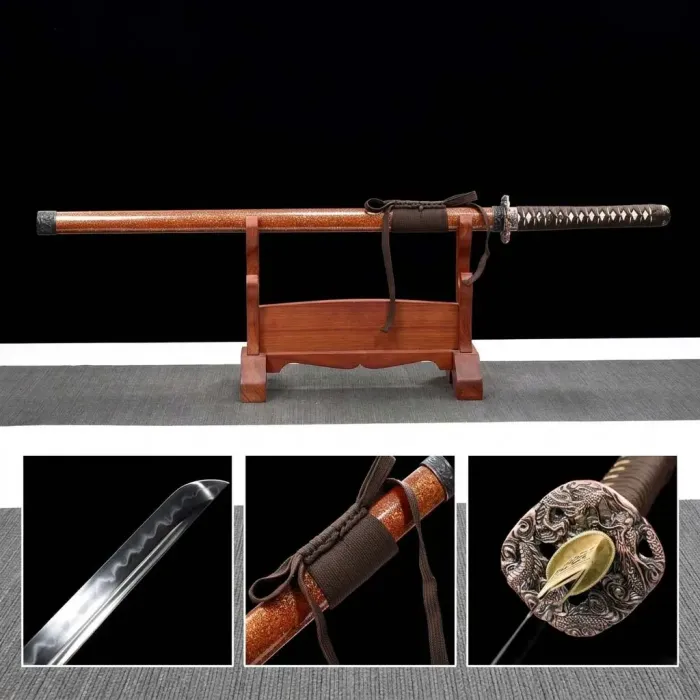
A time-honored Japanese sword exists as a exquisite piece of craftsmanship, but say you want to convey your personal character? Customizing your cutting tool is a fulfilling journey, allowing you to design a truly matchless piece. From the hilt wrapping and binding to the guard design and heat mark, each aspect offers a chance for tailored look. This investigation delves into the sphere of katana refinements, providing details for both initiates and experienced enthusiasts wanting to establish their mark on the traditional art of the samurai.
Freshman's True Artistry
For learners motivated to embark on the exciting journey of samurai sword fighting , 1060 steel katanas deliver an prime entry point. This specialized grade of structural steel achieves a ideal mix between low price and functionality . While less than hard as elite steels, 1060 provides a adequate level of edge development , making it perfect for starters to cultivate the preliminaries of blade preservation and appreciate the elegance of handcrafted Japanese weaponry. It’s a excellent choice for acquiring experience without the monetary burden of more high-grade steels.
Ten Ten Steel Sabers : Harmonizing Functionality and Expense
Providing for connoisseurs seeking an authentic cutlass experience without overpowering the cash reserve , T10 substance katanas represent a appealing option. These daggers offer a marked improvement in endurance compared to less expensive alternatives, exhibiting acceptable edge retention and adequate flexibility for basic incising techniques. While not rivaling the top-notch characteristics of ultimate steels like T100 or folded substance , T10 provides a distinguished blend of utility and price , making them a trendy choice for trainees and those on a narrow financial .
Past the Blade : Refining Your Edge's Components and Grip
As the finished sword is undeniably the central point of a katana, truly enriching its elegance lies in the cautious customization of its hardware and grasp . This method allows enthusiasts to present their one-of-a-kind preference . Assess the extensive possibilities: menuki - decorative adornments that supply visual appeal ; the hamon sheaths – often masterfully etched ; the tsuka nucleus itself, wrapped in classic ito binding ; and the fusa end piece , which can be designed from various components like gold or cartilage .
- Choose subjects that connect with you.
- Evaluate with diverse composites .
- Focus on robustness for a long-term result .
The Attraction of the Katana: Legacy, Artistry, and Steelwork
That historical weapon contains a unique allure, steeped in periods of Asian history and practice . More than merely a device of military action , it's a sign of the knight ethos – a fusion of mastery and command . Its evolution spanned numerous generations, with early cutting instruments evolving into the sophisticated curvature and fatal edge we accept today. The artistry involved is truly exceptional , requiring spans of preparation to attain . The process involves a elaborate folding of tamahagane , creating layers that strengthen the steel’s flexibility and cutting ability. Various schools of blacksmithing started , each with their special secrets and formulas for achieving the ideal equilibrium and edge - a truly strenuous pursuit.
- First Katana classes
- The importance of the traditional blade in samurai culture
- Ancient metalworking techniques
Choosing the Perfect Steel for Your Cutting Tool Project: 1060 vs. T10
Picking the proper steel is decisively important for any weapon project, and the option between 1060 and T10 can be complicated. 1060 is a prevalent American compound, offering a fair balance of resilience and sturdiness, rendering it somewhat easy to work. However, T10, a from Japan steel, typically boasts better wear resistance and can potentially achieve a amplified end hardness, although it can be substantially complex to operate and requires exact heat tempering. Consider your background and intended benefits: for a first-timer, 1060 may be a easier starting point, while the master smith might admire the augmented attributes of T10.
- Simplicity of Working
- Endurance
- Decisive Rigidity
Opening the Possibilities: Elite Katana Enhancement Procedures
Refining the technique of katana adjustment extends far beyond basic sharpening. Serious connoisseurs are now probing advanced techniques to truly reveal a blade's hidden potential. This demands intricate work with the temper design, utilizing specialized substances for differential processing and carefully picking the geometry of the shield to optimize balance and effectiveness. Beyond purely functional enhancements, artisans are increasingly focused on reaching unparalleled aesthetic beauty, through complex cutting and layered surfaces that truly transform a katana into a exquisite object.
Forging a 1060 Katana: From Raw Metal to Masterpiece
The journey opens with ordinary 1060 compound , a tough material far separated the refined katana it will turn into . Skilled bladesmiths practice a complex process of integrating and constructing the unrefined steel, repeatedly tempering it and beating it to rid T10 steel katana impurities and produce a homogeneous grain structure. This time-consuming process, often continuing for spans , builds the vital sturdiness and ductility characteristic of a authentic Japanese armament . Follow-up heat methods , including meticulous hardening and resting, are imperative to achieve the preferred equipoise of sharpness, longevity and attractiveness .- Overlaying: Reduces impurities and forms grain structure.
- Hammering: Creates the steel into the initial blade form.
- Heat Treatment: Defines the final hardness and flexibility.
The Enduring Appeal of the Katana: A Deep Dive into Steel and Customization
An historic katana holds present a intense symbol of Japanese heritage , its fascination far exceeding mere artillery . Forged from select steel and habitually featuring intricate designs , the process of creation itself is a revered art. Beyond the core craftsmanship, the ability to modify a katana - from the temper curve to the haft wrapping and clasp - affords for a sincerely individual demonstration for both worshippers and followers alike. This amalgamation of classical steelwork and boundless personalization creates the katana's continued widespread acceptance across the universe.
